
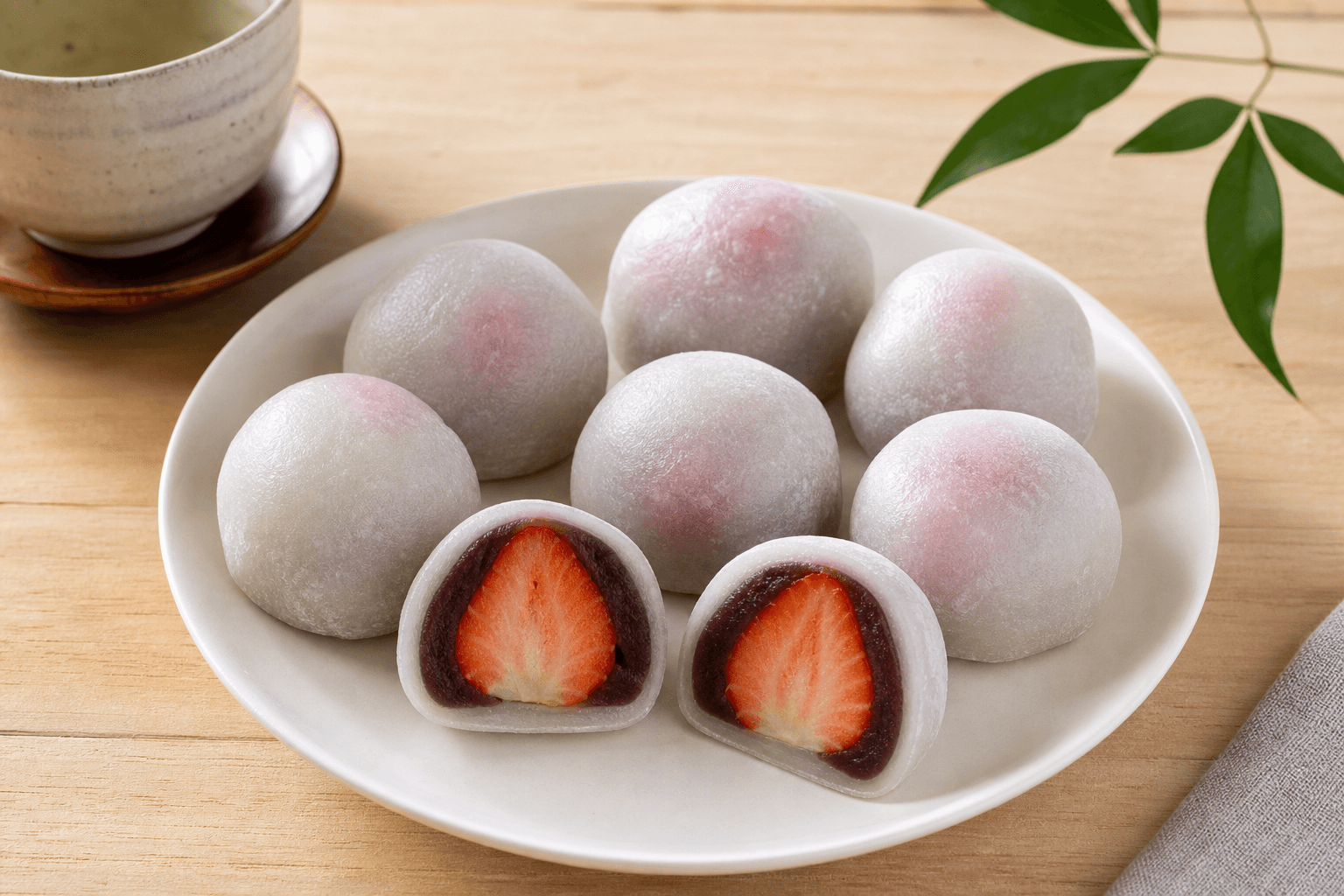
Strawberry Mochi
In Japan, ichigo daifuku is a modern creation within wagashi: it combines a whole strawberry with anko and a tender gyūhi wrap. The acidity and juiciness of the fruit balance the sweetness of the bean paste, while the glutinous rice provides an elastic and neutral texture. In this version, I prefer small strawberries and precisely measured hydration. Drying the fruit prevents the filling from sliding; cooking the dough until translucent confirms that the starch has completely gelatinized. Forming requires attention, but not force: a thin layer of starch controls stickiness, and a clean closure keeps each piece soft, uniform, and pleasant to share.
 Shared by The kitchen of Chef Yuki with the community.Ready to cook, save, and share from your family cookbook.
 Prep
Prep
35 min
 Cook
Cook
5 min
Total
40 min
 Yield
Yield
4 servings
 Origin
JP · Japón
Ingredients
- Glutinous rice flour (shiratamako)· Japanese glutinous rice flour100 g
- Water· at room temperature165 ml
- White sugar· white sugar30 g
- Salt· fineto taste
- Anko (sweet red bean paste)· sweet red bean paste, koshian or tsubuan, firm and cold200 g
- Strawberry· small, firm, and similarly sized8 piece
- Cornstarch· to control stickiness during forming40 g
- Matcha powderoptional· for a light finish1 teaspoon
Method
- 01
Wash the strawberries under running water without soap, and dry them completely with a clean paper towel. Remove the caps without cutting into the flesh; eliminating moisture prevents the anko from sliding and weakens the seal.
- 02
Divide the cold anko into 8 portions of 25 g. Flatten each portion, wrap a strawberry, and smooth the surface to form a compact filling; refrigerate the pieces at 4 °C for 10 minutes to maintain their shape.
- 03
Place the shiratamako in a microwave-safe bowl and add the water in three batches, breaking up the clumps with a spatula. Incorporate the sugar and salt until you have a smooth mixture; do not taste it while it’s raw.
- 04
Cover the bowl loosely and cook the mixture in the microwave at 800 W for 1 minute. Stir from the bottom, cook for another 45 seconds, and mix again; continue in 15-second intervals until the entire dough is translucent, shiny, and elastic, with no white areas.
- 05
Dust a tray and the spatula with cornstarch. Pour the gyūhi onto the tray and let it rest for 5 to 7 minutes until it cools down to about 45–50 °C; the freshly cooked dough is extremely hot and sticky.
- 06
Divide the warm gyūhi into 8 equal portions. With a thin layer of cornstarch on your hands, flatten each portion into a disc about 9 cm wide, leaving the center slightly thicker and avoiding dusting the inner face with starch so it can seal.
- 07
Place a filling of strawberry and anko in the center of each disc. Stretch the edges of the gyūhi upwards, pinch them shut, and leave the seam side down; work while the dough is still warm because it retains its elasticity better.
- 08
Brush off excess starch with a pastry brush and, if desired, lightly dust with matcha. Refrigerate the mochis at 4 °C or less within 2 hours after assembling and serve them close to their preparation, in manageable pieces that can be chewed well.
Chef tips
- You can use koshian, tsubuan, or shiroan; choose a firm paste that can be shaped without leaking.
- Do not substitute shiratamako with another glutinous rice flour without adjusting the water: the milling changes absorption and texture.
- If the dough retains white or opaque areas, cook it for another 15 seconds and mix again; do not taste the raw mixture.
- Refrigerate the mochis at 4 °C or less and consume them close to their preparation. Serve in small portions, eat slowly, and chew well to avoid choking hazards.
Classifications
More recipes by Chef Yuki
View chef profile 40 min
 70 min
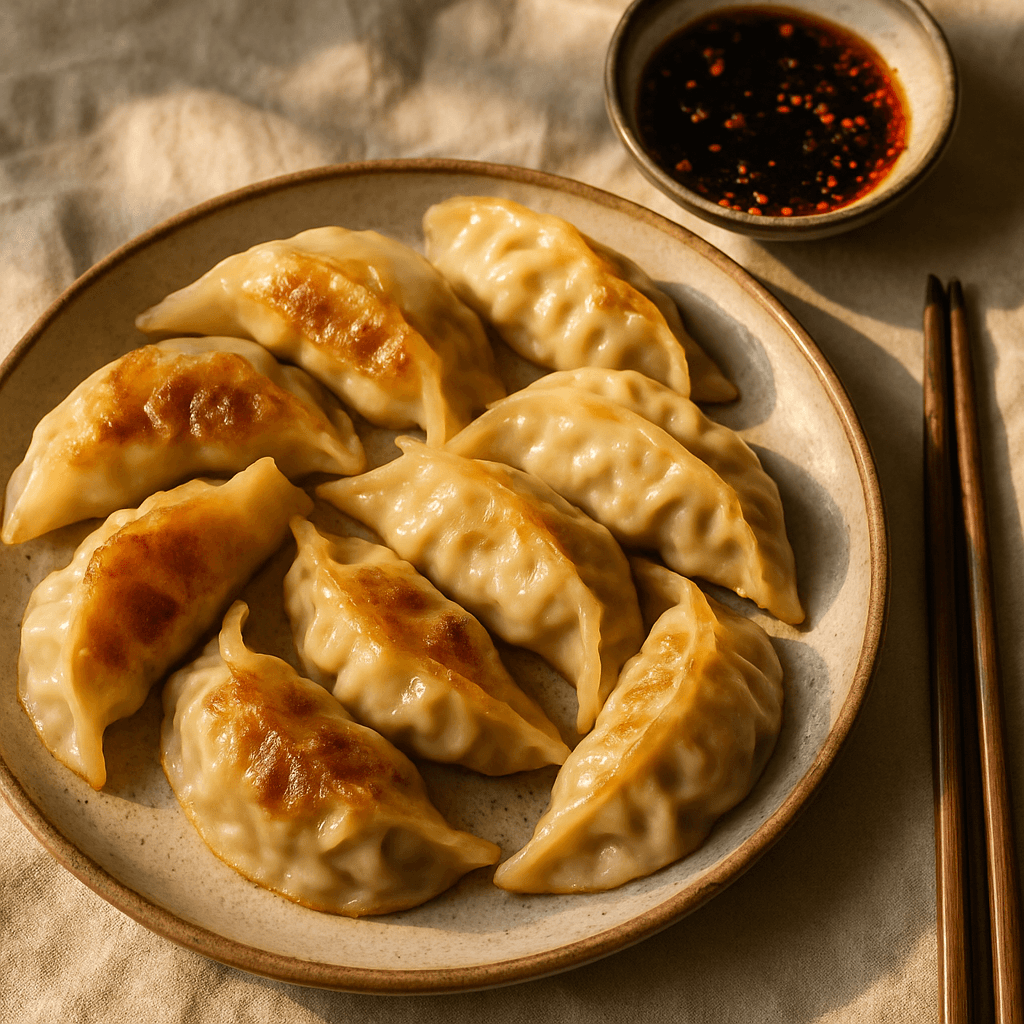
Homemade Gyozas
Homemade pork and cabbage gyoza: golden, juicy, and easy dumplings with soy sauce, rice vinegar, and chili.
More Japonesa
View cuisine hub40 min70 minHomemade Gyozas
Homemade pork and cabbage gyoza: golden, juicy, and easy dumplings with soy sauce, rice vinegar, and chili.